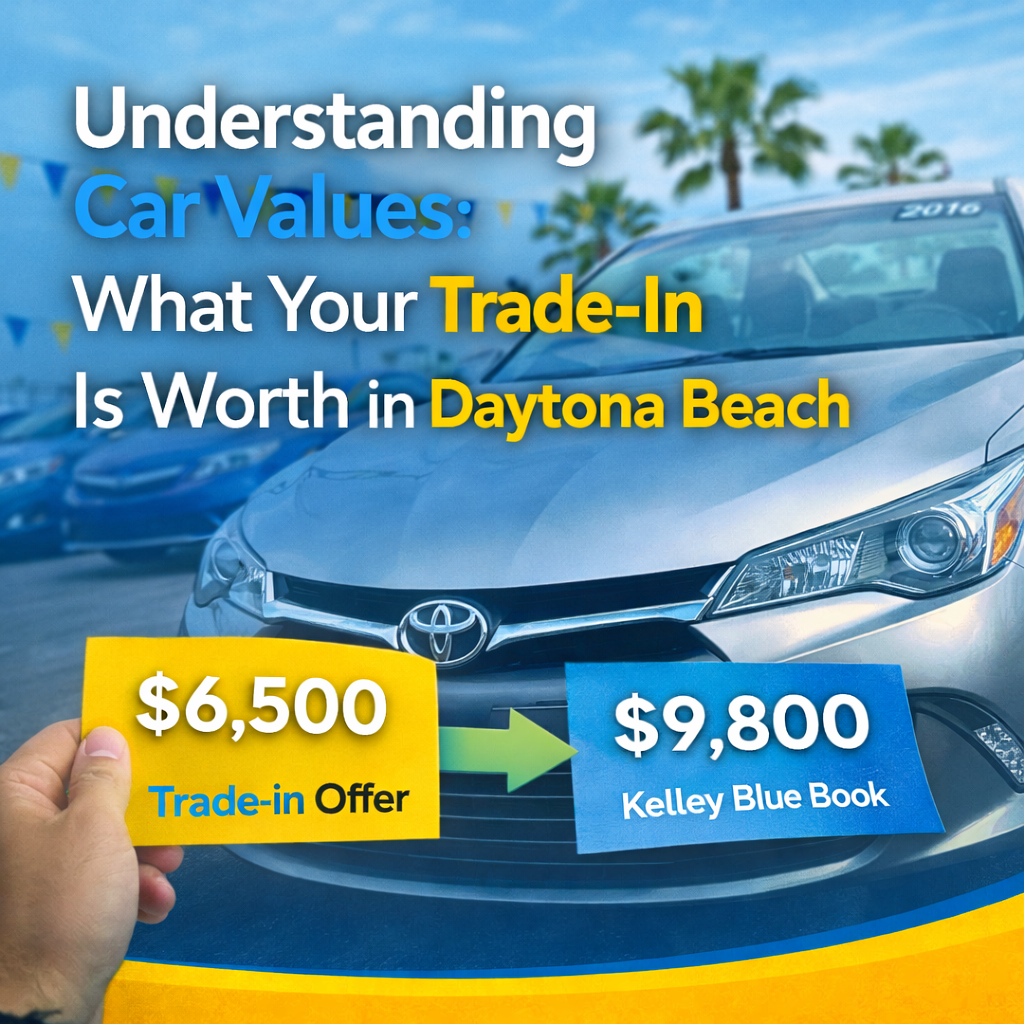
Your 2016 Toyota Camry has 78,000 miles, runs perfectly, and you’ve maintained it like clockwork. You walk into a Daytona Beach car dealership expecting a fair trade-in offer, and they tell you it’s worth $6,500. You check Kelley Blue Book later that night—it says $9,800.
What just happened?
Understanding what your trade-in is actually worth in Daytona Beach can put thousands of extra dollars in your pocket. The difference between an educated seller and someone who takes the first offer? Often $2,000 to $4,000. Let’s break down exactly how car values work at used car dealerships Daytona Beach and how to get every dollar your vehicle deserves when trading in.
How Daytona Beach Dealers Actually Value Trade-Ins
Here’s what most people don’t realize: your car has three different values, and dealers use the one that benefits them most.
Retail value is what the dealer will sell your car for on their lot. This is the highest number you’ll see.
Private party value is what you could sell it for yourself on Facebook Marketplace or Craigslist. This sits in the middle.
Trade-in value is what a dealer will actually give you. This is the lowest number, and it’s the one they’ll quote you.
Why the difference? Dealers need room for profit. They have to detail your car, perform safety inspections, potentially make repairs, pay for lot space, and still make money when they sell it. That margin comes from somewhere—and it’s the gap between what they give you and what they sell it for.
The Real Numbers Behind Daytona Beach Trade-Ins
Let’s use that 2016 Camry as a real example. In the Daytona Beach market right now:
- Retail value: $10,500 (what you’d see it listed for at a dealership)
- Private party value: $9,200 (what you could get selling it yourself)
- Trade-in value: $7,800 (what a fair dealer should offer)
That $6,500 offer? The dealer was trying to grab an extra $1,300 profit on top of their normal margin. Would you have known to negotiate if you hadn’t checked?
Most people wouldn’t. And that’s exactly what lowball dealers count on.
Check Your Car’s Value Before Setting Foot on a Lot
Do this before you visit any Daytona Beach dealership:
Get three different value estimates:
- Kelley Blue Book (kbb.com) – Industry standard, slightly optimistic
- Edmunds (edmunds.com) – More conservative, often more accurate
- NADA Guides (nadaguides.com) – Used by many dealers
Enter your car’s details honestly. That means actual mileage, real condition (not what you wish it was), and any issues it has. Lying to yourself now just means disappointment later.
Check local listings on Cars.com, CarGurus, and Autotrader. Search for your exact year, make, and model in Daytona Beach. What are similar cars actually selling for? Not listed at—selling for. That’s your real-world data.
Factor in Florida specifics. Cars in Florida often have less rust but more sun damage to paint and interiors. Your Daytona Beach trade-in value should reflect this regional reality.
What Actually Affects Your Trade-In Value
Some factors matter more than you think. Others? They’re basically irrelevant.
Mileage is king. A 2016 Camry with 60,000 miles is worth significantly more than one with 120,000 miles, even if both run great. High-mileage cars are harder to sell and riskier for dealers.
Maintenance records prove everything. Show a Daytona Beach dealer a folder full of oil change receipts, tire rotations, and brake service, and your value goes up. It proves you cared for the car and reduces their risk.
Exterior condition matters more than interior for trade-in value. Scratches, dents, and faded paint cost money to fix. Worn seats? Most buyers expect that on used cars.
Accident history kills value. Even if it was repaired perfectly, a car with an accident on the Carfax takes a 10-20% hit. No way around it.
Popular models hold value better. Your Honda Accord or Toyota RAV4 will get better offers than a Buick Regal, even in similar condition. Daytona Beach dealers know what sells quickly in Florida.
Things That Don’t Increase Trade-In Value (Sorry)
You spent $2,000 on aftermarket rims, a new stereo system, and custom leather seats. Your trade-in value went up by exactly $0.
Dealers don’t care about modifications. Often, they reduce value because the next buyer might not want them. Return everything to stock before trading in, and sell those upgrades separately if you want any return.
That $1,500 in recent repairs? Also won’t increase your offer. Dealers expect cars to be in working condition. You don’t get bonus points for fixing what should already work.
Extended warranties you purchased? Can’t transfer them to increase value. Most are tied to the original owner.
Timing Your Trade-In for Maximum Value
Believe it or not, when you trade in your car at Daytona Beach dealerships can affect what you get.
Tax season (January through April) is when car dealers Daytona Beach are hungry for inventory. People have refund money to spend on used cars Daytona Beach, and dealerships need cars to sell them. Your trade-in value might be 5-10% higher during this window.
End of month is when salespeople are trying to hit quotas at used car dealerships Daytona Beach. They need to close deals, which means they might bump your trade-in value to make the numbers work.
Avoid trading in right after major expenses. If your transmission just went out and you paid $3,000 to fix it, that repair won’t boost your trade-in value. You would’ve been better off trading in the broken car and letting the dealer deal with it.
Summer is peak used car season in Daytona Beach. Families are shopping for cars before road trips and school starts. Higher demand can mean better offers, especially for SUVs and minivans.
How to Negotiate Your Trade-In Value
Most Daytona Beach buyers make this mistake: they negotiate their trade-in and the new car price at the same time. This lets dealers play shell games with numbers.
“I can give you $8,000 for your trade instead of $7,500, but the new car price goes up $1,000.” You just lost $500 and thought you won.
Negotiate separately. Get the best possible price on the car you’re buying first. Only then discuss your trade-in. Treat them as two independent transactions.
Never say “I need to get X amount” for your trade-in. Dealers will structure the deal to show you that number while making up the difference elsewhere. Stick to your car’s actual market value.
Get offers from multiple Daytona Beach dealerships. Visit several car dealers Daytona Beach FL and get trade-in appraisals from each. One dealership might offer $7,200 while another offers $7,800 for the same vehicle. Use the higher offer to negotiate with others. Don’t limit yourself to just one used car dealer near me—shop around.
Consider selling privately if the trade-in offers are insulting. Yes, it’s more hassle. But for $1,500 to $2,500 extra, spending a weekend dealing with private buyers might be worth it.
What Dealers Look for During Trade-In Appraisals
When you hand over your keys at a Daytona Beach dealership, here’s what they’re actually checking:
They’ll run a Carfax or AutoCheck report. Accidents, title issues, service history—everything shows up here. They’re not trusting what you say; they’re verifying facts.
They’ll inspect the exterior for damage. Paint chips, dents, scratches, cracked windshields, worn tires. Each issue reduces their offer.
They’ll check under the hood. Oil leaks, worn belts, corroded battery terminals, low fluids. These signal deferred maintenance.
They’ll test drive it. Transmission shifts, brake response, unusual noises, check engine lights. Anything that affects safety or drivability costs them money to fix.
They’ll smell the interior. Smoke smell kills resale value. Pet odors aren’t far behind. Even if everything else is perfect, odor issues can drop your value 10%.
Clean Your Car (But Don’t Overdo It)
A basic detail can add $200-$500 to your trade-in value. Not because the car is actually worth more, but because it makes a better first impression on the appraiser.
Worth doing:
- Full interior vacuum, including under seats
- Wash and wax the exterior
- Clean the windows inside and out
- Remove all personal items and trash
- Shampoo fabric seats if stained
- Wipe down the dashboard and door panels
Not worth paying for:
- Professional paint correction ($300-$500) – Won’t increase value enough to justify cost
- Engine detailing – Dealers don’t care if the engine bay is spotless
- New tires – You won’t recoup the cost unless they’re dangerously bald
- Dent/scratch repair – Unless it’s severe, dealers factor these in already
The “We Need to Appraise Your Car” Tactic
You’re on a Daytona Beach car lot, looking at vehicles. The salesperson says, “Let me appraise your trade-in so we know what you’re working with.”
This is a control tactic. Once they have your keys, you’re stuck there while they “appraise” your car (which really means they’re figuring out how to structure the deal). You’ve lost negotiating leverage because leaving means interrupting their process and asking for your keys back—awkward.
Better approach: Tell them you’re not discussing trade-in until you’ve agreed on the price of the car you’re buying. If they insist, politely get your keys back and leave. Any dealer who won’t negotiate this way isn’t respecting you as a customer.
Should You Trade In or Sell Privately in Daytona Beach?
Honest answer: it depends on how much your time is worth and how much money we’re talking about.
Trade-in makes sense when:
- The difference between trade-in value and private party value is less than $1,500
- You still owe money on the car (dealers handle payoff directly)
- Your car has issues that would scare private buyers
- You want the transaction done in one visit
- You’re trading in a common car that dealers want
Sell privately when:
- Your car is in excellent condition and you can get $2,000+ more
- You have time to deal with test drives, tire kickers, and negotiations
- It’s a desirable model that sells quickly
- You’ve paid off the loan (selling with a lien is complicated)
- You’re not in a hurry to buy your next vehicle
Daytona Beach has active Facebook Marketplace and Craigslist communities. Popular models sell fast. If you’ve got a clean Honda, Toyota, or Ford truck, you can probably sell it in a week or two.
Understand the Tax Advantage of Trading In
Here’s something most Daytona Beach buyers don’t know: in Florida, you only pay sales tax on the difference between the new car price and your trade-in value.
Let’s say you’re buying a $20,000 car. Florida sales tax is 6%.
If you sell privately:
- You pay tax on $20,000 = $1,200 in sales tax
- You sold your old car for $10,000 (paid separately)
If you trade in:
- You pay tax on $10,000 ($20,000 – $10,000 trade) = $600 in sales tax
- You saved $600 in taxes
Even if a dealer offers slightly less than private party value, the tax savings might make up the difference. Do the math for your specific situation.
Red Flags During Trade-In Negotiations
You’re discussing trade-in value at a Daytona Beach dealership. Watch out for these warning signs:
They won’t show you how they arrived at the value. Legitimate dealers can explain their number. “Based on condition, mileage, and current market demand, here’s what we can offer.”
The offer drops significantly after “manager approval.” The salesperson offered $8,500, came back from talking to their manager, and suddenly it’s $7,200. This is a negotiation tactic, not a real appraisal.
They point out problems that don’t exist. “This transmission is slipping” when it shifts perfectly fine. They’re creating justification for a lower offer.
They pressure you to decide immediately. “This offer is only good today.” Translation: they’re offering less than it’s worth and don’t want you shopping it around.
They refuse to put the offer in writing. Always get trade-in offers in writing. If they won’t, they plan to change it later.
Get the Best Trade-In Value in Daytona Beach
Your strategy should be straightforward when dealing with used car dealers Daytona Beach:
Research your car’s value using multiple sources. Know what it’s worth before you talk to any dealer selling used cars Daytona Beach.
Clean your car and gather maintenance records. Present the best possible version of your vehicle to car dealerships Daytona Beach FL.
Get offers from at least three Daytona Beach car dealers. Use competition to your advantage when shopping the International Speedway Boulevard corridor.
Negotiate the new car price separately from trade-in value at car lots near me. Don’t let dealers play number games.
Consider the tax benefits and convenience of trading in versus the higher price of selling privately when buying used cars Daytona Beach.
Most importantly, don’t accept the first offer at any Daytona Beach dealership. Trade-in values are almost always negotiable, especially if you’re prepared with market data and competing offers from other car dealers Daytona Beach.
Your car is worth what you can prove it’s worth. Come armed with evidence, and Daytona Beach dealers will respect that you’ve done your homework.
Ready to get a fair trade-in value on your vehicle? View Car Dealers in Daytona Beach to find Daytona Beach car dealerships that provide transparent appraisals and competitive trade-in offers based on real market data. Compare multiple dealers, read reviews, and get the best value for your trade-in—no games, no pressure.